There is a type of photography everyone recognizes immediately. Saturated colors, warm light arriving from exactly the right direction, a subject occupying the frame with a precision that seems natural but isn’t. The viewer’s gaze moves across these images without friction, without resistance. There is something deeply comfortable in that. Something deeply false.
I think of Steve McCurry. I think of Alex Webb, Joel Meyerowitz. Three photographers whose technical mastery is indisputable, whose images have traveled the world, whose work is universally respected. And whose aesthetic represents exactly what I am building myself against.
McCurry makes portraits. Faces looking into the lens with a calibrated intensity, in a light that flatters every feature, within a context that says something about the human condition without ever disturbing the person looking. His images are beautiful like icons. They have the closed perfection of icons. They leave no space for anything to happen between the image and you. Everything is already resolved.
Webb is more complex. His multi-layered frames, his interlocking colors, his street scenes where three simultaneous actions respond to one another in a composition that feels choreographed. You look at his images and you see the work, the intelligence of the gaze, the patience of the positioning. You admire. And that is where something gets lost. As soon as an image makes me admire its construction, it has failed to make me forget that it is an image. Meyerowitz belong to the same family: photography as progressive mastery, as control over the visible world. Images that already know what they are before they are even looked at.
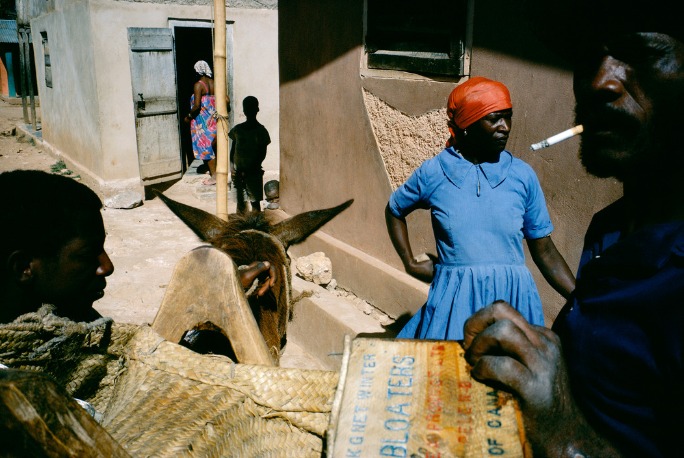
As soon as an image makes you say “that’s beautiful,” it has lost you. You are looking at the composition, not at what is inside it.
What I am looking for is the opposite. I am looking for what happens before I have had time to frame, to wait, to build anything. The shutter release that comes before conscious decision. The image that exists because something happened in my body before it passed through my mind. This is not an aesthetic of accident in the romantic sense, nor is it an anti-technical posture. It is trust in another kind of knowledge: physical, embodied knowledge, built over years of walking through cities, no longer needing calculation in order to function.
Moriyama does not compose. He collides. His way of working is that of a body in motion within a space in motion, the finger on the shutter like a nervous reflex. Klein is the tilted frame, the closeness that assaults. In both of them, there is an urgency that can be read in the image itself, not as a defect to be corrected but as proof that something truly happened. Michio Yamauchi goes even further in another direction — his images are silent, inward, almost still — but they share the same honesty about their own making. They do not claim perfection. They carry the trace of what they cost.
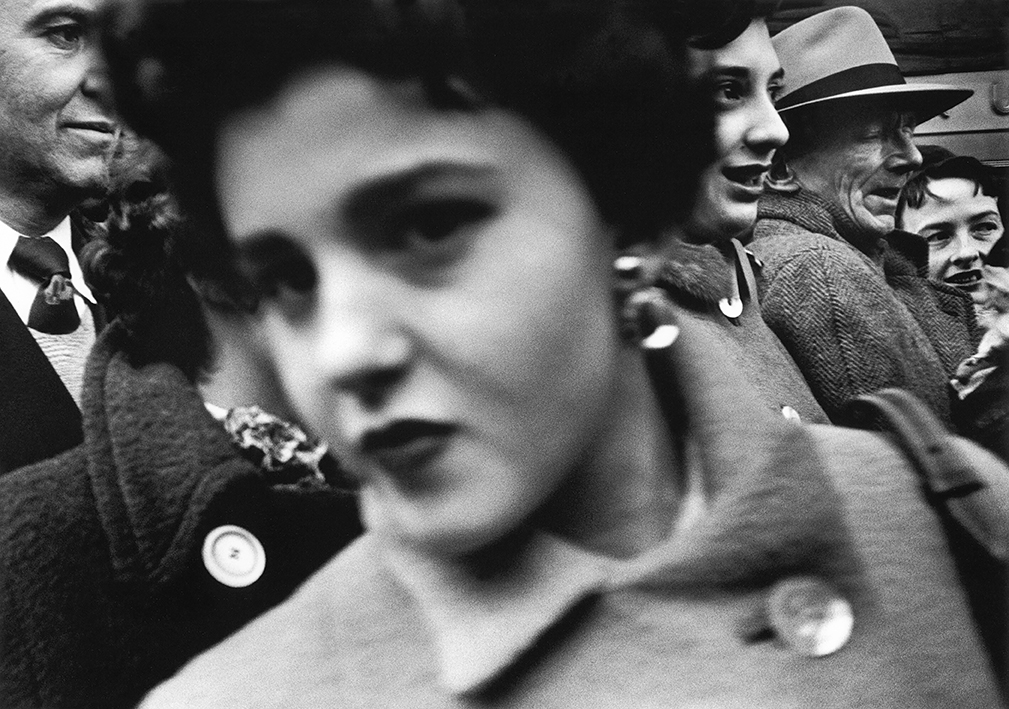
When I look at one of my images that is too clean, too well framed, I recognize it immediately. There is something dead inside it. An image where I had time to compose says that I had time. And if I had time, it means the moment was not urgent. And if the moment was not urgent, then perhaps it did not deserve to be photographed.
I have produced images like that. More often in the beginning, when I still believed photography was a matter of progressive mastery, that you became better by learning to control more. There is a photograph I took a few years ago in a street in Rennes: late-afternoon light, a man sitting on a bench, his head slightly tilted, his hands joined. Everything is in its place. It is a beautiful image. I look at it and I do not recognize myself in it. It looks like an image I might have seen somewhere and unconsciously reproduced. It looks like an idea of photography rather than a photographic act.
The difference between the two is not visible to the naked eye. Technically, there is nothing to criticize in that image. What is missing is what Moriyama calls urgency. That internal tremor that makes you press the shutter because you cannot not press it. When that urgency is there, the composition happens without me — or rather, it happens through me, without my being its conscious architect. The frame is not thought. It is felt. And in its imperfections, it carries the trace of that state.
That is why I trust the accident. Not because accident is aesthetically superior to mastery. Because accident is honest about the conditions of its own production. A blurred, misaligned, noisy image says something about the moment in which it was made. It carries the traces of speed, proximity, inner state. It does not hide its origin. The beautiful image erases its traces. It presents an ordered, legible, accessible world. A world that does not exist.
I do not shoot to produce images that please. I shoot to produce images that are true. And the truth of what I see in the street — the truth of solitude in the crowd, of anonymity, of bodies coexisting without touching — does not take the form of beautiful late-afternoon light on a face turned toward the lens. It takes the form of something almost missed. Something slippery, unstable, something that happened in the gap between two seconds and cannot be reconstructed afterwards.
I am not trying to master what I see. I am trying to let it reach me before I have had time to protect myself from it.
Formal perfection closes the image in on itself. It says: there, it is done, it is resolved. An imperfect image remains open. It leaves something suspended. It does not know everything it contains.
That is the space of uncertainty I work in. Not despite the accidents. Because of them.
Articles à lire
- Photographer or Author? Why This Opposition Is a False Question
- Farewell Photography by Daido Moriyama: when photography stops trying to be beautiful
- Street photography doesn’t need to be spectacular
- Why does black-and-white photography minimize the background?
- “Street photographer” no longer means anything