There is a question one almost always ends up encountering after photographing for a long time: does a photograph have to be beautiful?
The question seems simple. It is not. It has run through photography since its origins, but it feels even more urgent today, at a time when images are judged in a matter of seconds, often on a tiny screen, inside a flow that does not forgive slowness, ambiguity or discomfort. An image has to hold attention. It has to seduce quickly. It has to be readable, efficient, shareable. It has to produce an immediate effect.
But is a photograph that works quickly necessarily a strong photograph? Is a beautiful photograph necessarily a true one? And conversely, can a blurry, grainy, poorly framed, excessive, almost unreadable image contain something deeper than a perfectly controlled image?
These questions are not only theoretical. They directly affect the way we look, walk, photograph, select our images and build our language. They also affect the way we accept, or refuse, to step outside a comfortable idea of photography.
For a long time, I believed that a good photograph had to be beautiful. Not only interesting, not only necessary, not only true: beautiful. I looked for beautiful light, beautiful composition, beautiful landscapes, beautiful contrast, the image that immediately gives the feeling of being successful. I thought a photograph had to prove something through its mastery.
Then certain images came to crack that certainty. Among them, those of Daido Moriyama. And even more so, his book Farewell Photography, published in 1972 under the Japanese title Shashin yo Sayonara. A radical, unstable, often difficult book, which sometimes seems to attack photography from within rather than simply use it.
This text is not only an article about Moriyama. It is an attempt to understand what Farewell Photography can still teach us today: about beauty, failure, poor images, social media, artificial intelligence, and this contemporary obsession with producing immediately effective images.
Because perhaps photography truly begins only when it stops trying to be beautiful at all costs.
Beauty as an invisible norm
Beauty seems self-evident. We look at an image and say: it is beautiful. Soft light, balanced composition, a readable subject, harmony of forms, a seductive atmosphere. The judgment seems natural, almost immediate. Yet it never truly is.
What we call beautiful is shaped by our visual culture. By the images we have seen, by the books we have opened, by the photographers we admire, by the social media platforms we consult, by the aesthetic norms of our time. Beauty is not only a quality of the image. It is also a construction of the gaze.
Philosophy has long reminded us of this. In Kantian aesthetics, the judgment of beauty is not an objective knowledge of the object. The Stanford Encyclopedia of Philosophy recalls that, for Kant, aesthetic judgment is based on a feeling of pleasure or displeasure. It belongs to taste, not to a cold, stable and universal measurement.
This does not mean that everything is equal. It means that beauty is never as obvious as it pretends to be. When an image seems beautiful to us, it is not simply responding to an external rule. It is also meeting an expectation, a habit, a memory, an education of the gaze.
The problem begins when this norm becomes invisible. When we no longer see it as a norm, but as photography itself. We then end up believing that a successful image must be clean, sharp, balanced, harmonious, readable. Everything that moves away from this norm seems suspicious. Too blurry. Too hard. Too dirty. Too fragmentary. Too brutal. Too poor. Too poorly composed.
But this reaction often says more about our habits than about the image itself.
A technically perfect photograph can be dead. An imperfect photograph can be overwhelming. A seductive image can disappear as soon as it has been seen. A difficult image can remain in memory for years. A photograph that does not resemble what we expect can first provoke rejection, then become precisely the one that shifts our gaze.
It is this shift that interests me.
When I was trying to produce beauty rather than photograph
For a long time, I tried to make beautiful images. At one point, this mostly meant landscape photography. I photographed places, then spent hours in editing software. I added layers, worked on colours, strengthened contrasts, made the sky denser, the light more dramatic, the atmosphere more magical.
The result could be seductive. But looking back, I think I was not really photographing what I saw. I was photographing what I would have liked to see.
This is not necessarily something to condemn. Many photographers go through this. We often start by imitating. We look for reference points. We reproduce images we admire. We learn to build, to balance, to make a scene stronger than it was in front of us. At the beginning, copying can be a form of learning.
But there comes a moment when copying becomes a cage. We no longer photograph in order to see. We photograph in order to resemble what we believe a good photograph should be. We look less for an image than for validation. We want to produce something that belongs to an already recognized family: the spectacular landscape, the perfect light, the effective composition, the rendering that pleases.
I think I was also trying to leave. To escape my immediate environment. I lived in a region without sea, mountains or waterfalls. Everything that seemed photographable was elsewhere. Photography became an excuse to leave the everyday, to search for escape, for dream, for a form of beauty outside my own life.
But perhaps I was not only fleeing a territory. Perhaps I was fleeing what frightened me: the human, the banal, proximity, the street, everyday life, bodies, uncertainty. Landscape allowed me to keep a distance. It allowed me to compose without being confronted with the unpredictability of the other.
I thought I was looking for beauty. In reality, perhaps I was looking for shelter.
Leaving one’s own visual cave
There is something very comfortable about an aesthetic norm. It gives us criteria. It tells us what to admire, what to reject, what to consider successful. It avoids doubt. It gives the impression of seeing clearly.
But sometimes, this clarity is only a cave.
The image is well known: in the allegory of the cave, Plato describes prisoners who mistake the shadows projected in front of them for reality. The Getty Museum summarizes this situation as men chained in place, looking at shadows on a wall and taking them for reality itself.
This metaphor interests me because it describes our relationship to images quite well. We sometimes believe we are looking at photography, when we are mainly looking at the shadows of our photographic habits. We think we are judging freely, when in fact we are reacting from criteria we have absorbed without questioning them.
Leaving this cave does not mean rejecting all beauty. That would be too simple. It means rather understanding that what we call beautiful is not neutral. That our tastes have a history. That our rejections do too. That the immediate disgust we feel before an image can sometimes signal not the weakness of the image, but the limit of our own gaze.
This is exactly what happened with Daido Moriyama.
The rejection of Daido Moriyama
The first time someone told me about Daido Moriyama, I did not understand. I did not see a major photographer. I saw grain, blur, aggressive framing, subjects that seemed to have no importance. I saw dark, hard, sometimes almost unreadable images. I saw everything I had learned to avoid.
My first reaction was rejection.
This rejection was aesthetic, but not only aesthetic. It was also defensive. Moriyama was attacking precisely the criteria on which I had built myself. He did not look for beautiful light. He did not seem to look for balance. He did not seem to respect sharpness, composition, or a clear hierarchy of subject. His images seemed dirty, nervous, accidental. They did not ask for admiration. They imposed friction.
His aesthetic is often associated with the Japanese formula are, bure, boke: grainy, blurry, out of focus. PHmuseum, writing about the Photo Elysée retrospective, recalls that this aesthetic became one of Moriyama’s signatures, especially in the context of the Provoke generation.
But reducing Moriyama to grain and blur would be a mistake. Grain is not a decorative style. Blur is not an effect. Brutal framing is not a pose. All of this participates in a way of exploding the stable image. In Moriyama’s work, photography does not seem to want to clarify the world. It seems rather to record its violence, speed, confusion and unstable surface.
That is why I did not understand him immediately. I was looking at his images with the very criteria they were trying to displace.
I was asking Moriyama to produce a beautiful photograph. He seemed to answer with another question: what is a photograph when one stops asking it to be beautiful, clear and well behaved?
Returning to what we once rejected
Sometimes a work rejected too quickly comes back. We think we have dismissed it, but it remains somewhere. It works in silence. It returns in another form, at another moment, when the gaze is a little less defensive.
After that first rejection, I continued to look at photographers. Many of them. Humanist photographers, street photographers, colourists, documentary photographers, more instinctive authors, more frontal authors, more experimental authors. Doisneau, Cartier-Bresson, Orkin, Meyerowitz, Leiter, Haas, Gruyaert, Eggleston, Parr, Klein, Winogrand, Araki, Moriyama. The list matters less than the movement.
The more I looked, the less photography seemed reducible to a single idea of beauty. Each photographer shifted a boundary. What one tried to organize, another tried to break. What one made readable, another made troubled. What one sublimated, another deliberately damaged. What one patiently constructed, another seemed to tear from the flow.
Little by little, I returned to Moriyama.
This time, I was no longer only trying to know whether his images were beautiful. I was trying to understand why they held. Why they stayed. Why they continued to produce something in me despite their violence, their apparent poverty, their refusal of beautiful form.
And that is when Farewell Photography became important.
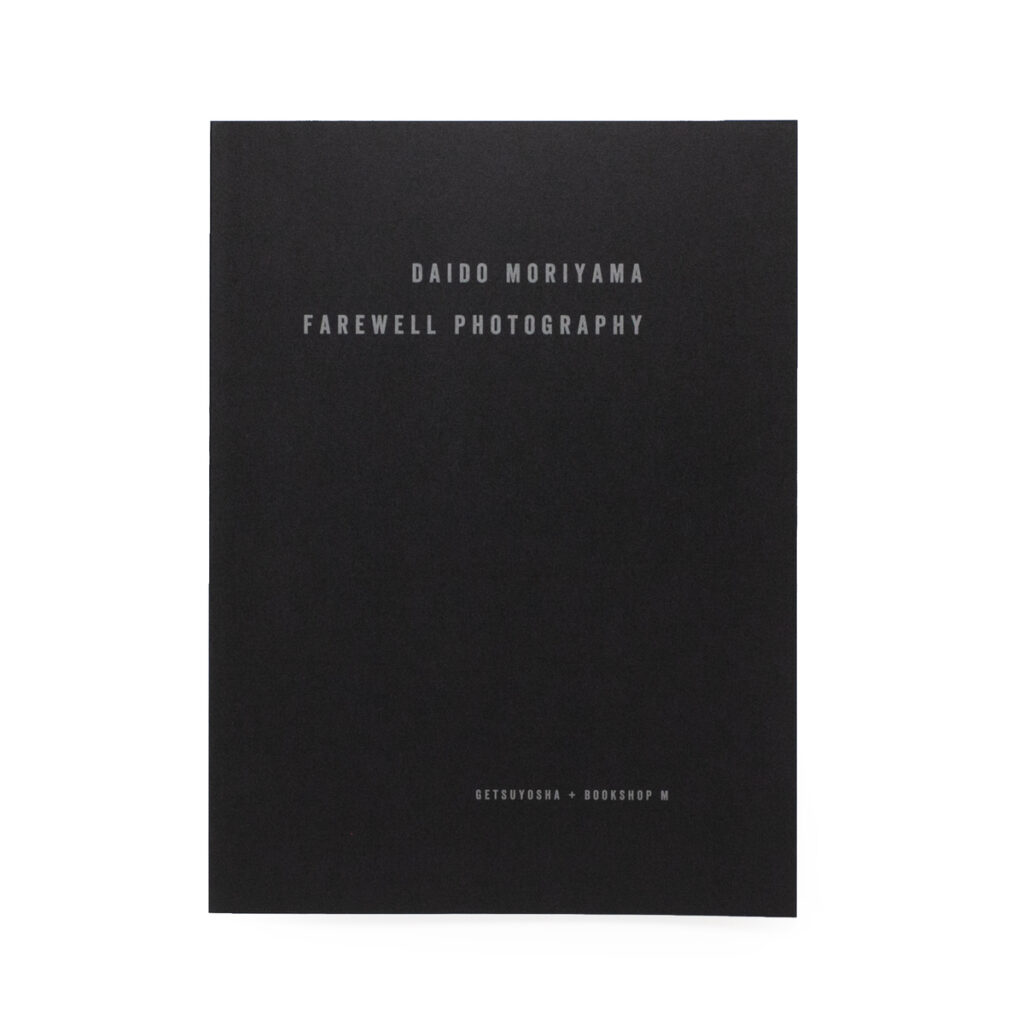
Farewell Photography: saying goodbye to photography or saying goodbye to its rules?
Farewell Photography was published in 1972. Its original title, Shashin yo Sayonara, can be translated as Farewell Photography or Bye Bye Photography. From the title, something is already set: this is not simply a book of photographs. It is a gesture against photography itself, or at least against a certain idea of photography.
Polka Galerie presents Farewell Photography as one of the major events in the history of the photobook, a radical exploration of the limits of photography and its expression. This is not an excessive statement. The book does not try to show a well-photographed world. It tries to put the photographic act itself into crisis.
The images are often extreme. Violent contrasts, blocked shadows, burned whites, degraded matter, re-used images, photographs of television screens, fragments, accidents, prints that sometimes seem closer to noise than to representation. The book gives the impression of photography undoing itself before our eyes.
Photo Elysée, in its dossier dedicated to Moriyama, writes that after deconstructing the photographic medium in Farewell Photography, Moriyama went through a deep personal and artistic crisis. This point is important: the book is not only a formal provocation. It involves a crisis. It puts into play an existential relationship to the image.
Jan-Frederik Rust’s dissertation, Provoking a Farewell to Photography: The Aesthetic of Moriyama Daido’s Early Photobooks and Magazine Work (1965–1978), is valuable on this point because it situates the book within the broader context of Moriyama’s early work, between photobooks and magazines. The subject is not only an isolated style, but an aesthetic built over several years, in dialogue with printed photography, reproduction, the press, the book and the very limits of the medium.
What interests me in this approach is that Farewell Photography no longer appears as a simply strange or extreme object. It becomes the condensation point of a broader question: how far can photography be pushed before it stops resembling what we expect from it?
The book seems to say goodbye to photography as proof, as mastery, as correct composition, as clear surface, as transparent window onto reality. It does not say goodbye to the image. It says goodbye to a naive trust in the image.
And that is precisely why it remains so current.
A photography that sabotages itself
What is striking in Farewell Photography is that the book sometimes seems to sabotage what we expect from a photobook. Where we expect coherence, it offers rupture. Where we expect readability, it offers opacity. Where we expect image quality, it offers degradation. Where we expect narrative progression, it imposes a more fragmentary, almost abrasive experience.
This sabotage is not gratuitous. It attacks a precise idea: the idea that photography is a medium naturally capable of showing reality. As if the camera recorded the world neutrally. As if photography were evidence. As if seeing an image were enough to understand what took place.
Farewell Photography challenges this confidence. It shows that an image can be poor, accidental, reproduced, damaged, almost unreadable, and still continue to act. It shows that photography is not only a window. It is also a surface, a material, a printed object, a fragment torn from a chain of reproductions.
Aperture rightly insists on the difficulty of understanding Moriyama. In an article titled “Why Daido Moriyama’s Radical Vision Is Misunderstood”, the author reminds us that the question raised by Moriyama — what is a photograph? — is too vast to receive a simple answer. It is precisely this absence of a definitive answer that makes his work so important.
A beautiful photograph often gives the impression that something has been resolved. A photograph by Moriyama, especially in Farewell Photography, seems instead to prevent resolution. It does not stabilize. It does not console. It does not offer a beautiful form in which the gaze can rest.
It leaves the question open.
And this openness can be more powerful than beauty.
The poor, dirty, unstable image
We have to be careful not to fall into a misunderstanding. Saying that a photograph does not need to be beautiful does not mean that failure is enough. A blurry image is not automatically deep. A badly framed image is not automatically alive. A dirty image is not automatically radical.
Failure does not automatically become language. But a language can accept failure.
This is where Moriyama is important. He does not simply make “failed” images. He constructs a relationship to photography in which what we usually call defects can become part of the experience: grain, blur, excessive contrast, loss of information, brutal cropping, re-used images, poor printing.
In another context, these elements would be corrected. Here, they become active. They are not merely tolerated. They are part of the way the image thinks.
An overexposed photograph can express the violence of light. A blocked black can become a mental mass. Blur can translate the speed of an encounter. An image torn from a television screen can question the reproduction of images. A brutal frame can say something about the street that a polite composition would have neutralized.
Photography then becomes less a representation than a shock of surfaces. It no longer seeks only to show what was in front of the camera. It also shows the difficulty of seeing, the degradation of memory, the instability of reality, the violence of reproduction.
This point is essential if we are not to misunderstand Farewell Photography. The book does not say: everything is allowed, therefore everything is interesting. It says rather: the rules of good photography are not enough to define what an image can be.
That is an immense difference.
Beauty as a prison
Beauty becomes problematic when it stops being a possibility and becomes an obligation.
This is not about rejecting beautiful images. Some photographs are beautiful and necessary. Some forms of beauty genuinely open the gaze. The problem is not beauty itself. The problem is beauty as reflex, as norm, as sole criterion, as compulsory horizon.
When photography has to be beautiful, it begins to avoid everything that disturbs its beauty. It avoids accident. It avoids tension. It avoids the banal. It avoids dirt. It avoids confusion. It avoids the image that does not explain itself immediately.
It becomes reassuring.
But photography does not always have to reassure. It can unsettle. It can resist. It can frustrate. It can leave the gaze in a state of uncertainty. It can refuse to provide immediate aesthetic satisfaction. It can even be displeasing at first, and become necessary later.
This is what Farewell Photography taught me to understand. The book did not simply show me that one could make blurry or grainy images. It showed me that photography could exist outside the desire for approval. Outside the beautiful image. Outside the composition that asks to be admired.
It taught me to look at a photograph not only by asking whether it is beautiful, but by asking what it puts into crisis.
The connection with my own work
I do not want to turn Moriyama into a model to imitate slavishly. That would be the greatest misunderstanding. Copying Moriyama is not understanding Moriyama. Adding grain, blur and contrast to an image is not enough to produce a true photograph. It can even become a new recipe, a new aesthetic prison, a new recognizable style to reproduce.
But there is an authorization in his work. Not the authorization to do anything, but the authorization to move one’s own limits. To look differently at what one once rejected. To understand that photography is not only an art of mastery, but also an art of loss.
Loss of control. Loss of sharpness. Loss of information. Loss of the central subject. Loss of comfort. Loss of the beautiful image as shelter.
In my own relationship to street photography, this opened something. I began to accept proximity more, accident more, cut bodies, images that were too harsh, blacks that were too present, situations without an obvious subject. I began to trust images that could not immediately justify themselves.
I have already written elsewhere that I do not seek the beautiful image. This article extends that idea differently. It is not about repeating that formal perfection can kill a photograph, but about understanding how Farewell Photography made another relationship to the image possible: a relationship less submitted to beauty, less submitted to readability, less submitted to immediate effectiveness.
The difference is important. Refusing the beautiful image can become a posture. Understanding why an image does not need to be beautiful requires deeper work. It forces us to question our own criteria, our own rejections, our own habits.
And that is often uncomfortable.
Social media: the return of beauty as a prison
If Farewell Photography remains so contemporary, it is also because we live in an age that has reinstalled beauty as a norm, but in a new form.
Social media does not only ask images to be beautiful. It asks them to be immediately effective. An image has to work in the flow. It has to hold attention before the thumb moves upward. It has to be readable in a small format, produce a quick emotion, be identified in one second, trigger a reaction.
Contemporary beauty is often optimized beauty: strong contrast, obvious subject, clear composition, recognizable atmosphere, instantly identifiable visual signature. It is no longer only about beauty. It is about performance within a system of distribution.
Walter Benjamin had already shown that technical reproduction profoundly changed the status of the work of art. In The Work of Art in the Age of Mechanical Reproduction, he notably analyzes the disappearance of aura linked to the uniqueness of the work in time and space. Today, with social media, this question shifts again: the image is no longer only reproducible, it is instantly distributed, evaluated, forgotten.
We no longer only look at photographs. We consume flows of images. We scroll, we like, we move on. An image can touch us for a fraction of a second, then immediately disappear, replaced by another. This mode of consumption naturally favours simple, strong, readable, immediately understandable images.
The problem is not sharing one’s work on social media. The problem begins when social media becomes the prescriber of our taste.
An image that works on Instagram is not necessarily a strong image. It may simply be adapted to its environment. It may have understood the rules of the flow. It knows how to stop the gaze, how to provoke a quick reaction, how to resemble what the algorithm and users already recognize.
But an important photograph does not always work quickly. Some images require time. Some images do not seduce immediately. Some images cannot be understood as thumbnails. Some images need a book, a sequence, silence, slowness.
Farewell Photography belongs to this family of images that resist the flow. Not because they are impossible to reproduce, but because they do not deliver quick satisfaction. They do not try to be loved immediately. They ask the gaze to accept a loss of comfort.
A like is not an aesthetic judgment
The like has become one of the poorest gestures in our relationship to images. It can mean many things: I like this, I saw this, I support this, I recognize this, I validate this, I want to save this, I want to encourage this, I want to remain visible to this person. But it does not necessarily mean: this image is strong.
A like is not an aesthetic judgment. It is a quick reaction inside a technical architecture designed to measure engagement.
A photograph can be liked because it is beautiful. But it can also be liked because it is simple. Because it confirms an expectation. Because it resembles what we have already liked. Because it asks for little effort. Because it belongs to a trend. Because it uses the right codes at the right time.
Conversely, a more ambiguous photograph can be ignored not because it is weak, but because it is not adapted to the rhythm of the flow. It asks for too much time. It does not immediately give away its subject. It offers no quick reward. It does not easily become a social signal.
This is where Moriyama’s lesson becomes precious. Farewell Photography does not try to be “likable”. The book does not ask the reader to validate every image. It imposes an experience. It forces us to go through something. Some pages seem almost hostile. Some images seem to refuse to be looked at as classical photographs.
And yet, it is precisely this resistance that gives them their strength.
In an age where the image is often thought of as content, Moriyama reminds us that photography can be something other than high-performing content. It can be friction. A disturbance. An object that cannot be reduced to its ability to circulate.
AI: beauty without experience
A new question now further complicates our relationship to beauty: artificial intelligence.
Generative AI can produce impressive images. It can fabricate a night street, a face, a landscape, a light, a crowd, a scene that resembles a photograph. It can imitate black and white, grain, blur, harsh light, apparent imperfections. It can even produce an image that vaguely resembles Japanese street photography from the 1970s.
UNESCO reminds us that AI can now generate images of people, places and scenes that have never existed, and that this transformation directly affects photography and image-making. In an article titled “Artificial intelligence and art: a decisive moment?”, the organization points out that some image banks are already filled with algorithmically generated content.
The question, then, is not only whether AI can produce beautiful images. It already can. The real question lies elsewhere: what is a beauty produced without experience of the world worth?
A photograph is born from an encounter. A body in a place. A distance. A hesitation. Sometimes a fear. A walk. A fatigue. A changing light. A stranger passing too quickly. A failed image just before. A choice made in a fraction of a second. A physical presence in the world.
A generated image can imitate the signs of this encounter. It can produce grain, contrast, a silhouette, a simulated accident, a dark city, a stray dog, a nervous atmosphere. But it does not return from a walk. It has not hesitated before raising the camera. It has not felt the gaze of a stranger. It has not got lost. It has not waited. It has not missed the previous image. It carries no fatigue.
This is where the problem becomes profound. AI can produce a beautiful image, but photography cannot be reduced to the production of an image. It is also an experience, a relationship to reality, a movement of the body, a confrontation with what resists.
UNESCO’s report on artificial intelligence and culture emphasizes the challenges these systems raise for cultural diversity, creation, artists and cultural professionals. Applied to photography, this question becomes concrete: what happens to a practice based on presence in the world when images can be produced without presence?
This is not a reason to deny the existence of AI, nor to pretend that it will never produce interesting images. But it is a reason to clarify what we expect from photography.
If we expect only a beautiful image, AI will often be enough. If we expect a trace of experience, then the question remains open.
Gaining time, but losing what?
One of AI’s great promises is saving time. Writing faster. Producing faster. Retouching faster. Generating faster. Testing faster. Obtaining an image without going through learning, failure, waiting, movement.
This promise is seductive. Who has never dreamed of knowing how to draw, write, compose, photograph or create without going through years of practice? Who has never wanted to reduce the gap between an inner idea and its realization?
But in art, time is not only an obstacle. It is part of the formation of the gaze.
The time to walk. The time to look. The time to fail. The time to copy the masters, then understand that one must move away from them. The time to reject a work, then return to it several years later. The time not to understand. The time to let an image act slowly.
In photography, the detour is not always a waste of time. It is sometimes the exact place where the gaze is formed.
If Farewell Photography interests me so much, it is also because this book cannot be reduced to a visual recipe. One can ask AI to produce a grainy, blurry, contrasted image inspired by an experimental Japanese aesthetic. But that will not produce the historical, existential and material experience of Farewell Photography. It will not produce Moriyama’s crisis. It will not produce the relationship to the book, to printing, to reproduction, to post-war Japan, to the press, to the street, to the exhaustion of the medium.
One might obtain a resembling image. But resembling is not being.
This difference becomes essential in the age of AI. The more beautiful generated images become, the more we will have to ask what beauty alone cannot produce.
Why Farewell Photography remains contemporary
Farewell Photography is a book from 1972, but it seems to me more contemporary than many current images.
Not because it resembles our time, but because it resists what our time expects from images.
Our time often expects images to be clean, fast, efficient, beautiful, optimized, shareable, immediately understandable. Farewell Photography does almost the opposite. It dirties the image. It slows understanding. It destroys the clear hierarchy of the subject. It makes photography unstable. It refuses beauty as a guarantee.
In an age saturated with visual content, this refusal becomes precious. The book reminds us that an image does not only exist to circulate. It can also resist circulation. It can prevent fast consumption. It can ask for another form of attention.
The Fondation Henri Cartier-Bresson, writing about the exhibition Daido Moriyama: Love Letters to Photography, recalls that Shashin yo sayonara broke with the rules of “good” photography. This expression is essential. It shows that the issue was not simply to produce a different style, but to challenge the very expectations that defined what a good photograph was supposed to be.
This is where the book continues to speak to us. Every age has its rules of good photography. Yesterday, they could be linked to sharpness, printing, composition, technical mastery. Today, they are also linked to visibility, social performance, compatibility with platforms, the ability of an image to work instantly.
Saying goodbye to photography today would perhaps not mean abandoning the camera. It would mean saying goodbye to the idea that the value of an image depends on its ability to please quickly.
No longer asking a photograph to be beautiful
I do not believe we should brutally oppose beauty and truth. That would be too simple. An image can be beautiful and true. An image can be harsh and superficial. An image can be technically poor and deeply empty. Nothing is automatic.
But I believe the question must be shifted.
Instead of first asking a photograph whether it is beautiful, we can ask it something else. Does it hold? Does it resist? Does it open something? Does it carry a tension? Does it keep a part of opacity? Does it continue to act after the first glance? Does it carry an experience? Does it exist as something other than a validatable image?
Beauty is not the enemy. The enemy is the obligation of beauty.
This obligation impoverishes photography because it reduces the field of possibilities. It makes us believe that an image has to seduce before it can exist. It pushes us to correct what might become alive. It turns accident into defect, roughness into a problem, ambiguity into weakness.
Farewell Photography helps me think the opposite. It reminds me that an image can be excessive, poor, unstable, almost unreadable, and yet necessary. It reminds me that a photobook does not have to seek to please, but can shift our understanding of the medium. It reminds me that photography is not only a matter of successful images, but also of images that put our very idea of success into crisis.
Conclusion: what remains after the beautiful image
I no longer want to ask a photograph whether it is beautiful. Or rather, I no longer want to begin there.
Beauty can come. It can appear despite everything. It can emerge in a blurry image, in a black that is too dense, in a brutal frame, in an almost unreadable fragment. But it is no longer the goal. It is no longer the condition of existence of the image.
What Daido Moriyama’s Farewell Photography taught me is that photography can survive the loss of its certainties. It can survive the loss of sharpness, perfect composition, immediate readability, beautiful surface. It can even find a new strength there.
In a world saturated with fast, beautiful, optimized images, generated or shared to hold a few seconds of attention, this lesson becomes essential. Photography does not need to be reduced to what works. It does not need to bend entirely to dominant taste, social metrics, the expectations of the flow, beauty produced as a visual commodity.
It can still be an experience. A disturbance. A walk. A fatigue. A failure that opens something. An image that does not immediately know why it exists, but still continues to exist in the gaze.
Perhaps this is what Farewell Photography finally leaves us: not a definitive goodbye to photography, but a goodbye to the too narrow idea we had of it.
And sometimes, one has to say goodbye to beautiful photography in order to begin seeing what an image can truly become.
Comments