There are labels that simplify, and labels that suffocate. “Street photographer” belongs to the second category. It’s convenient for algorithms, useful for juries that need boxes to tick, efficient for Instagram bios that have to fit into three words. It says something true about part of what I do. It erases everything else.
Let me tell you what that label has produced in recent years: thousands of “street photography” Instagram accounts with the same framings, the same carefully constructed urban geometries, the same layering of overlapping silhouettes in pools of light, the same children running through cobbled alleys turned into picturesque subjects. A catalog aesthetic, endlessly reproducible, recognizable at first glance and forgotten two seconds after the scroll. Street photography has become a genre with its codes, its contests, its influencers, its Lightroom presets. It has become fashionable. And whatever is fashionable no longer disturbs anyone.
Street photography originally had something else. Garry Winogrand shot from the hip without looking through the viewfinder, thousands of rolls left undeveloped at his death—a way of working that looked less like photography than like a physical compulsion. Leon Levinstein moved into bodies, into the crowd, with a proximity that bordered on indecency—something unsettling and uncomfortable in every image. Trent Parke worked in the street as if in a trance—dark, instinctive, inhabited by something that had nothing to do with composition or patience. There was something punk in all of this, something uncomfortable—a way of occupying public space that hadn’t asked for permission. That energy still exists in some. It’s drowned in the mass of what the genre has become.
What bothers me most is street portraiture. This tendency to stop people, ask them to pose, photograph them in beautiful light with their explicit consent and their best smile, then call it street photography. It’s studio photography outdoors. There’s nothing inherently wrong with that. But it has nothing to do with what interests me, and the fact that both practices share the same label says a lot about the level of confusion within the genre.
Another way of working
What I do doesn’t have a simple name.
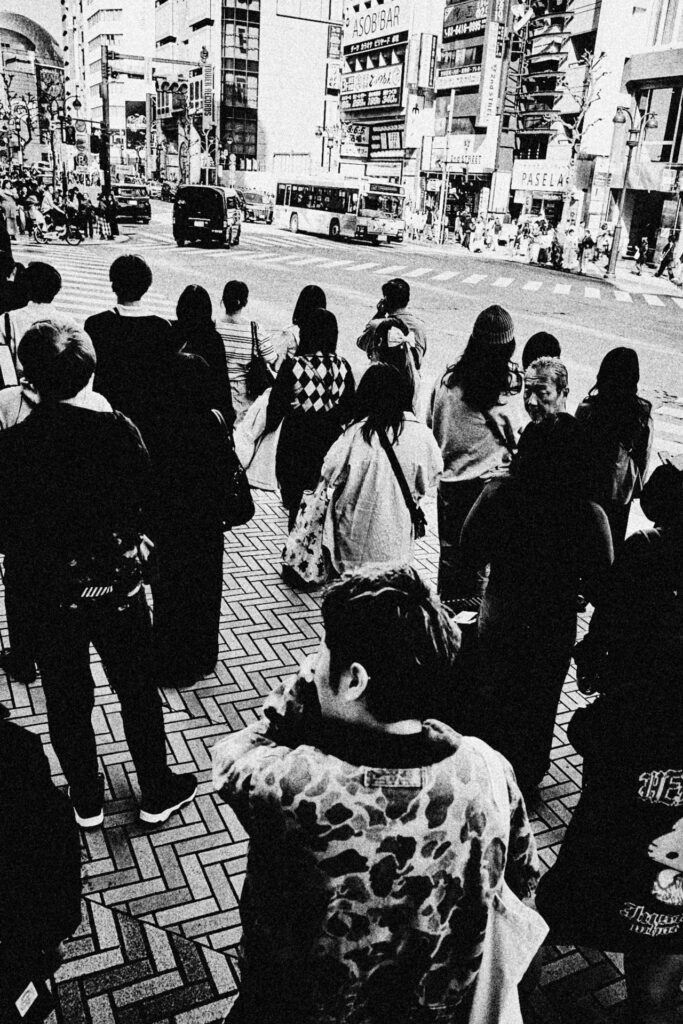
I’m someone who expresses feelings using everyday theater. The street is not my subject. It’s my material—the space where something happens that touches me, challenges me, passes through the body before it reaches the mind. I keep moving. When something happens, I press the shutter—twice at most, in under two seconds, without stopping. I don’t compose, I don’t frame consciously, I don’t construct an image. I react. The image exists because something in me recognized something outside, and that dialogue happened too quickly for the intellect to interfere.
Calling that “street photography” is like calling boxing “conflict management.” It’s not wrong. It misses the point.
What interests me in everyday theater is not picturesque scenes, perfectly executed decisive moments, or elegant urban geometries that click into place. It’s states of being. The way people exist in collective space when they think they are not being watched. Solitude in the middle of the crowd, anonymity as a permanent condition of urban life, bodies coexisting without touching, without seeing each other, each enclosed in their own bubble of presence. These states are fleeting—impossible to provoke, impossible to wait for. They either exist or they don’t. My only job is to be there when they do and to have the reflex to shoot before they disappear.
That reflex has nothing to do with technique. It comes from years of walking through cities, sustained openness, a particular state of presence that resembles dérive in the Situationist International sense of the term, but is also something more physical, more animal. You don’t search—you move. You don’t compose—you react. You don’t select the right moment—you are present when the moment arrives.
Documenting the street or documenting oneself
Street photography, as it is mostly practiced today, is a photography of patience and positioning. You find a good spot, good light, an interesting background. You wait for someone to enter the frame. You shoot. It’s a valid approach. It produces clean, well-constructed, technically controlled images. It leaves me completely cold because it tells the story of the place, not the person photographing it.
What I want my images to convey is the state I was in when they were taken—the speed, the proximity, the degree of disturbance or clarity of that precise moment. Grain, blur, misalignment—these are not aesthetic accidents. They are data. They say something about the real conditions in which the image was produced, about what my body knew before my mind understood anything.
A photographer who waits twenty minutes in a good spot for a perfect image produces a photograph that reflects that patience, that calculation, that control. It’s beautiful. It doesn’t resemble me.
I’m not trying to document the street. I’m trying to document myself through it.
The distinction is total. It implies a different way of moving, a different way of selecting, a different way of looking at one’s own images. Above all, it implies a different way of understanding what one is doing and why.
So no, “street photographer” does not define me—not in the way the genre has defined itself, not in the way it is practiced, not in the way it presents itself on social media and in competitions. I’m someone who walks through cities with a camera, trying to translate into images what the world does to them.
If you have a word for that, I’ll take it.