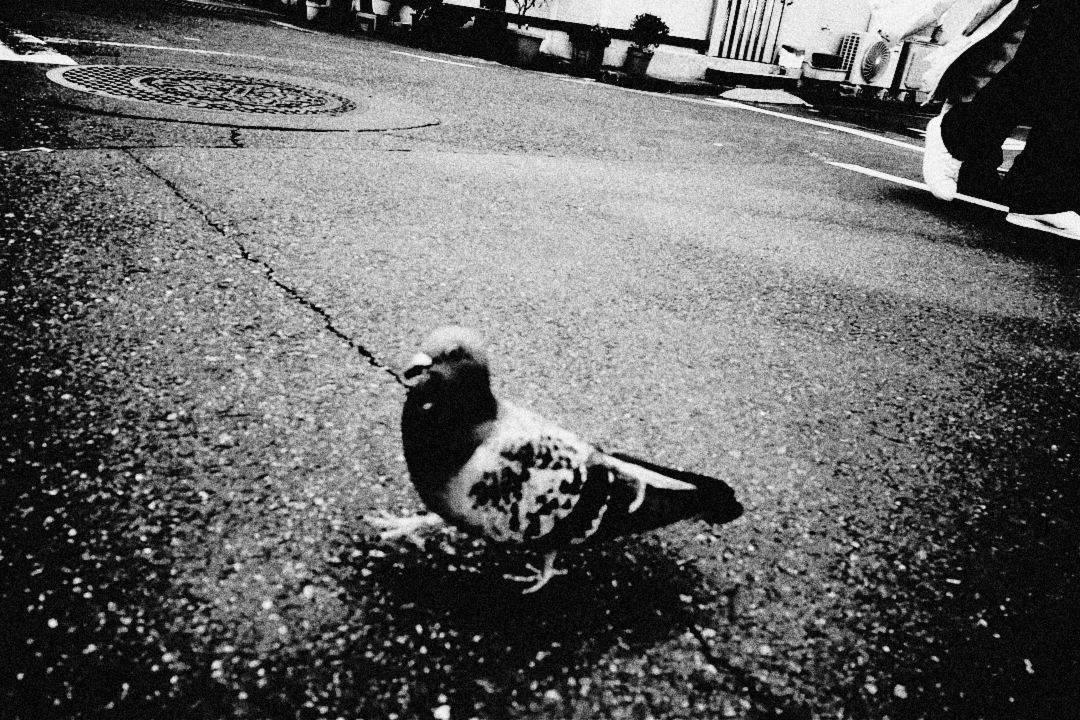
Black and white street photography does not need to be spectacular
There is a fairly common idea that a good street photograph should immediately produce an effect. It should surprise, make people smile, create a visual shock, contain a perfect coincidence, an ideally placed silhouette, a sharp shadow, a funny gesture, a composition so obvious that it feels as if it had been drawn in advance.
This idea is not entirely wrong. Street photography has often been built around attention to the moment, to chance, to the unpredictable encounter between forms and bodies in public space. The MoMA defines street photography as a practice almost as old as the medium itself, in which photographers look for their subjects in streets and public places. Britannica also describes street photography as a genre that records everyday life in public places, often isolating moments that would otherwise go unnoticed.
But something has shifted.
After looking at street images online for years, after scrolling through thousands of photographs in contests, hashtags, portfolios and Instagram accounts, a certain idea of street photography has become dominant. An effective street photograph would be an immediately readable photograph. An image that works fast. An image that is understood before it is even truly looked at. An image that offers its little visual mechanism at first glance.
A man walks past a poster and his head replaces the printed character’s head. A silhouette crosses a perfectly geometric patch of light. A passerby seems to be carrying a shape located behind him. A shadow falls exactly where it should. An urban scene becomes a graphic joke. It is often well seen. It is sometimes highly controlled. But it is not everything street photography can be.
Black and white street photography can also be less spectacular. More nervous. More ambiguous. Harder to grasp. It may not try to prove its intelligence immediately. It can resist the eye, refuse the visual punchline, remain open, strange, almost uncomfortable. It may not explain right away why it exists.
And perhaps that is where it truly starts becoming interesting.
The trap of the perfect moment
Street photography has long been associated with the idea of the decisive moment. This expression, attached to Henri Cartier-Bresson, has deeply shaped the way we talk about photography. It suggests that a strong image is born from the exact meeting point between a situation, a form and an instant.
This notion remains essential, but it can become reductive when understood as a formula. In an article dedicated to the practice of Henri Cartier-Bresson, Magnum reminds us that the idea of the decisive moment can obscure other dimensions of photography: temporality, intuition, memory, the subconscious, and everything that precedes or extends beyond the act of pressing the shutter.
The problem, then, is not the decisive moment itself. The problem begins when it becomes a recipe.
In a certain kind of contemporary street photography, the decisive moment has sometimes turned into the spectacular moment. It is no longer only about being attentive to life, but about waiting for the perfect alignment that will produce an immediately rewardable image. The photographer then looks for the scene that will work fast: the one that will make people laugh, the one that will give the impression of a miraculous accident, the one that can be understood as a thumbnail on a screen.
This logic changes the way one photographs. It pushes the photographer to look for already predictable scenes. You spot a poster, a shadow, a graphic background, a patch of light, then wait for someone to enter the frame. The gesture can be perfectly legitimate. It can produce very good images. But it can also trap street photography in a mechanism that is too visible: interesting background, well-placed passerby, shutter release, effect.
The image then becomes a demonstration.
It says: look how well I saw. Look how perfect the alignment is. Look how reality produced an amusing coincidence. Look how everything is in place.
But a strong photograph does not always need to work as proof.
An image can be deeper when it cannot be reduced to its trick. It can last longer when it does not give everything away in the first second. It can be more unsettling when it does not rely on a visual joke, a perfect symmetry or a spectacular event. Reality is not always theatrical. The street is not always a stage waiting for its gag. The city is also made of fatigue, waiting, friction, unfinished gestures, lost gazes, cut bodies, presences that cross paths without meeting.
Black and white street photography can take all of this seriously.

The spectacular is reassuring because it explains the image
A spectacular image is reassuring. It gives the viewer a clear reason to look at it. It contains its own instruction manual. We quickly understand why it exists: because one form responds to another, because a situation is funny, because a composition is perfect, because something remarkable happened in front of the camera.
This type of image is not necessarily weak. Some spectacular photographs are magnificent. Some images built around an immediate effect remain powerful precisely because they go beyond their own mechanism. But many spectacular street images are quickly exhausted. Once we have understood their principle, there is almost nothing left to look at.
Ambiguity works differently.
An ambiguous image does not immediately deliver its reason for being. It does not say: this is what you should see. It lets the eye move around. It allows the viewer to hesitate. It can produce a sensation before it produces an explanation. It does not necessarily try to resolve the scene. It may even preserve a degree of opacity.
In artistic street photography, this opacity is essential. It prevents the image from becoming a simple visual anecdote. It lets doubt, tension, memory and disturbance enter the frame. It gives the viewer an active role. They do not simply receive information or an effect; they have to stay with the image, return to it, accept that they may not understand everything.
This is especially true in black and white.
Black and white street photography removes some of the information that usually helps us recognize the world. Colour situates, explains, prioritizes. It tells us the season, the hour, the atmosphere, the fashion, the context. Black and white seems to simplify, but it often makes reading the image more complex. It removes the descriptive comfort of colour in order to bring forms, masses, contrasts and tensions between bodies and space to the surface.
In a spectacular image, black and white can reinforce the graphic impact. In a more nervous or ambiguous image, it can do something else: it can make the scene less stable, less narrative, less immediately consumable. It can turn an ordinary situation into a mental fragment. It can make a banal detail feel strange. It can give the street a density that does not rely on the event, but on sensation.
Photographing the street is not only about waiting for the event
The street is often photographed as a place of events. We look for what rises out of the flow: an unusual gesture, a visual collision, an absurd scene, a meeting between two worlds. But the street is also made of non-events. And these non-events are sometimes more accurate.
A man waiting. A woman crossing without any particular expression. Two bodies passing each other without seeing one another. A hand resting on a window. The back of a neck in a crowd. A leg leaving the frame. A silhouette crushed by a facade. A face lost in a mass of reflections. Nothing spectacular. Nothing that deserves an obvious title. Nothing that tells the viewer: this is the subject.
And yet, something is there.
The strength of contemporary street photography can emerge from this attention to almost nothing. Not because everything is interesting by principle, but because certain images reveal a discreet tension in situations that seemed insignificant. Photography does not always create an event. Sometimes it makes us feel that an inner event has taken place without being named.
What strikes us in certain photographers like Garry Winogrand is not only the event. It is instability. Frames can tilt, gestures can cross, bodies may not reveal themselves clearly, scenes may seem caught on the edge of disorder. The Metropolitan Museum of Art notes that his work moves through a wide variety of subjects and shows post-war American life as a continuous flow, full of possibilities but also marked by anxiety.
This photography does not always try to be beautiful in the classical sense. It tries, rather, to be alive.
And life, in the street, is rarely perfectly composed.
The overly perfect image can become closed
A perfect composition can be admirable. But it can also become a prison. When everything is too well placed, when every line leads exactly where it should, when every element confirms the photographer’s intention, the image can lose a part of its danger.
It becomes closed.
The eye enters, understands, validates, leaves.
A less perfect photograph can sometimes hold the viewer for longer. Not because it is clumsy, but because it keeps within itself an unresolved tension. An edge of the frame too close. A cut silhouette. A missing piece of information. A black area too dense. A partially hidden face. A composition that seems almost unbalanced. All of this can produce a particular energy.
Black and white street photography handles this tension very well. It does not need to be clean. It does not need to be illustrative. It can be rough, unstable, fragmentary. It can accept that the world overflows the frame.
This idea connects with the history of certain more personal forms of documentary photography. The exhibition New Documents, organized at MoMA in 1967, brought together Diane Arbus, Lee Friedlander and Garry Winogrand around a new way of looking at reality. The book published by MoMA around this exhibition recalls that these three photographers, still relatively little known at the time, were brought together by John Szarkowski in an exhibition that became decisive in the history of American photography.
This shift matters: documentary photography does not always have to explain a social subject from the outside. It can become more personal, more existential, more troubled. It can look at the world without necessarily commenting on it in an obvious way.
This is a valuable path for thinking about black and white street photography today.
Photographing the street does not necessarily mean producing a clear image about society, the city or people. It can also mean coming into contact with confusion. Photographing the world as it appears: incomplete, contradictory, crossed by signs that do not always fit together.
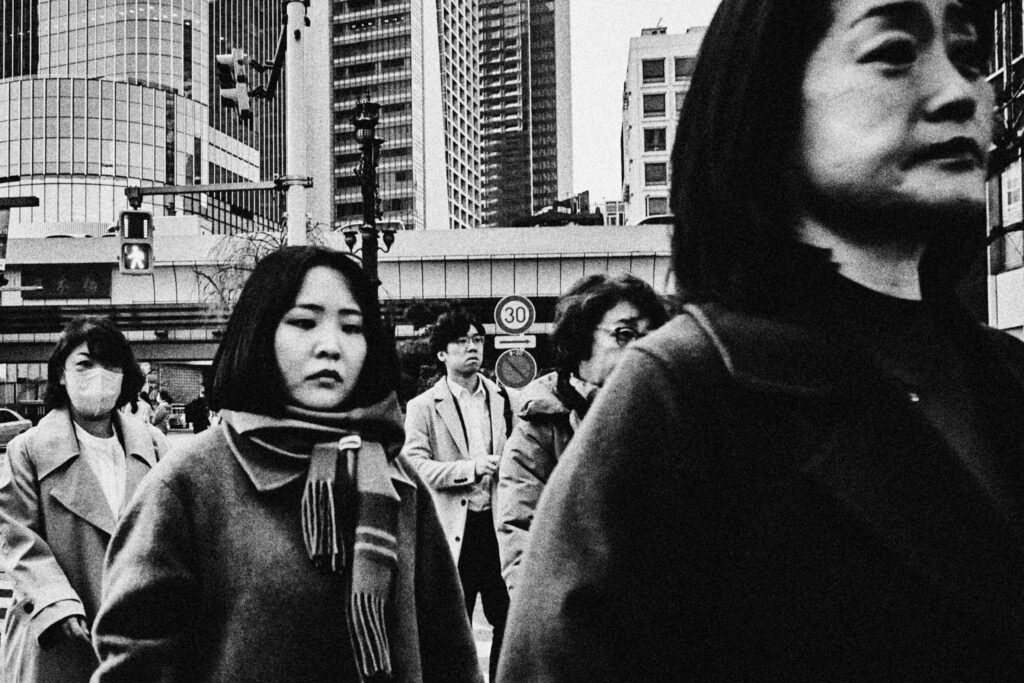
Nervousness as a form of sincerity
A nervous photograph is not a failed photograph. It can be a more accurate way of approaching the street.
The street moves. Bodies move. The photographer moves. Situations appear and disappear before they can be understood. In this space, overly controlled photography can sometimes seem foreign to what it claims to show. It imposes stability on a world that has none.
Nervousness, on the other hand, can restore something of the real experience of the street: speed, proximity, uncertainty, collision. It can make us feel that the photographer was not at a distance, but inside the flow. Not looking down from above, but physically engaged in the scene.
This nervousness can take several forms.
It can be in the framing, when the image cuts bodies or refuses a composition that is too comfortable. It can be in the light, when the blacks swallow part of the information. It can be in the blur, when movement becomes more important than detail. It can be in proximity, when the subject is too close to be looked at calmly. It can be in the absence of hierarchy, when the eye does not immediately know where to settle.
In urban black and white photography, this nervousness can become a language. It is not about doing anything at random. On the contrary, it requires great attention. One must feel when imbalance produces tension, and when it produces only confusion. One must accept that the image is not perfectly readable, without letting it become empty. One must leave room for accident, but not confuse accident with the absence of vision.
The difference is important.
An ambiguous image is not a weak image. An open image is not a vague image. A nervous image is not a neglected image. It can be constructed differently, with less politeness, less obviousness, less desire to please immediately.
Black and white is not only there to look “artistic”
Black and white is often used as a sign of artistic intention. It immediately gives the image a sense of gravity. It creates distance from ordinary reality. It can make a scene feel more timeless, more graphic, more dramatic. But this use can become superficial if it only serves to make a photograph appear more “serious”.
In black and white street photography, monochrome should be more than an effect.
It should be a way of looking.
Black and white removes the distraction of colour, but it does not automatically simplify the image. On the contrary, it forces us to think differently. Relationships of light become essential. Masses matter more. Textures become more visible. Bodies detach themselves or disappear depending on the contrasts. A banal scene can become denser because the image no longer relies on the immediate recognition of things.
Colour often says: this is what you see.
Black and white sometimes asks: what remains when you can no longer rely on colour to understand?
This is why black and white can support a less spectacular form of street photography. It can hold an image that is not trying to seduce immediately. It can strengthen the strangeness of a small gesture. It can turn a partially visible face into an almost abstract presence. It can transform an ordinary street into a mental space.
Black and white street photography is therefore not merely a vintage aesthetic or a tribute to the great photographers of the twentieth century. It remains a contemporary language, provided it is not used as a filter of legitimacy. It must participate in the tension of the image. It must change the way we read the scene. It must make possible a form of concentration that colour might have dispersed.
Ambiguity against the fast consumption of images
Today, we look at photographs in a saturated environment. Images move fast. They have to capture attention in a fraction of a second. This speed naturally favours spectacular photographs: strong contrast, obvious subject, visual gag, immediately readable composition.
Street photography does not escape this logic. An image that works in a small format on a phone is more likely to be noticed. A funny or perfectly aligned scene is easy to share. A photograph that demands time, however, risks disappearing into the flow.
But this risk is also a position.
Choosing less spectacular photography means refusing to reduce the image to its immediate performance. It means accepting that a photograph may not give everything away in one second. It means defending a slower relationship with looking.
A strong image is not necessarily the one that brutally stops the scroll. Sometimes it is the one that returns afterwards. The one we do not know exactly what to think about. The one that seemed almost like nothing, then stays. The one that does not deliver a clear meaning, but a persistent sensation.
This inner duration is precious.
It distinguishes the illustrative image from the photographic image. An illustrative image works because it clearly shows an idea. A strong photographic image can work because it contains more than its idea. It keeps a part of reality unresolved. It does not close entirely around an intention.
In artistic street photography, this resistance to fast consumption may be one of the most important issues. It is not about making deliberately obscure images in order to appear deep. It is about letting photography keep its ability not to explain everything.
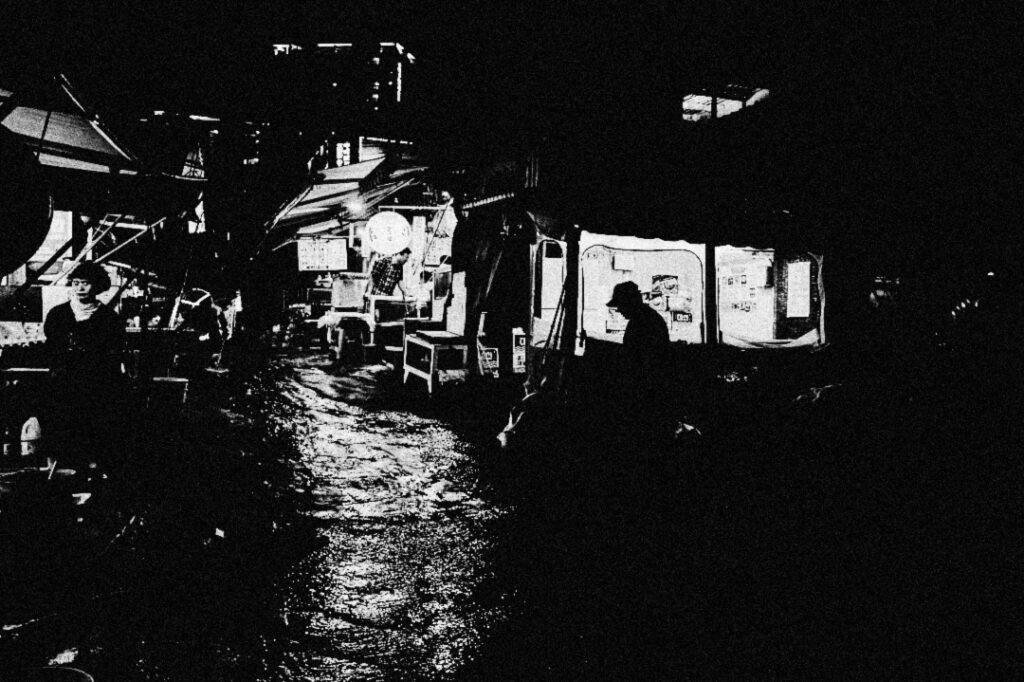
The banal is not the enemy of street photography
Many beginner photographers think they have to find exceptional scenes. They wait for something extraordinary. A rare situation. An unusual character. An urban event. But the street is rarely spectacular on command. And when we look only for the exceptional, we become blind to what truly makes up everyday life.
The banal is not empty. It is simply difficult to look at.
Photographing the banal requires a particular kind of attention. It is not enough to point the camera at an ordinary scene. One must feel what, within that scene, creates tension. A relationship between two people. A strange distance. A light that cuts the space. A posture that says something unintentionally. A detail that shifts the reading. A human presence even when no face is clearly visible.
Black and white street photography can give the banal a particular intensity. Not by artificially transforming it, but by revealing its structure. Black and white can make invisible lines of force appear. It can isolate a gesture. It can turn waiting into tension. It can make an ordinary street feel almost theatrical without any spectacular event taking place.
But we must remain careful.
The banal does not become interesting simply because it is banal. A bad photograph of an ordinary scene remains a bad photograph. The question is not to glorify insignificance. The question is to develop sensitivity to what, in the ordinary, already contains visual, human or mental charge.
This is where the photographer’s eye becomes decisive.
Not because it captures “the” perfect moment, but because it recognizes a faint tension before it disappears.
Street photography as a physical experience
Street photography is often described as an art of observation. This is true, but insufficient. Street photography is also a physical experience.
There is a distance to find. A walking rhythm. A way of entering the flow or stepping out of it. A way of accepting proximity without always seeking control. Street photography is made with the eyes, but also with the body.
This physical dimension is essential to understanding why an image can be nervous. A photograph taken at close range does not say the same thing as a photograph taken from far away. An image made while walking does not carry the same energy as an image patiently composed from a fixed point. A photograph made in uncertainty sometimes keeps the trace of that uncertainty.
In black and white street photography, this trace can become visible. Grain, contrast, deep blacks, cut silhouettes, reflections, movements, accidents of light can translate the way the photographer moved through the scene.
It is not only what is photographed that matters. It is the position from which the image was made.
A spectacular photograph can sometimes give the impression that the photographer waited for the world from an ideal position. A more nervous photograph can give the opposite impression: the photographer was caught in the world, crossed by it, almost pushed around by it. The image does not only show a scene; it shows an encounter between a body, a camera and a fragment of reality.
This encounter can be awkward, imperfect, unstable. But it can also be more sincere.
Not explaining everything
There is a current tendency to accompany images with explanations. We explain the context, the intention, the place, the approach, the meaning. This can be useful. In some documentary projects, it is even necessary. But street photography sometimes loses part of its power when it is over-explained.
A strong street image does not need to say immediately why it exists.
It can remain there, before us, without delivering its programme. It can refuse the clear sentence. It may not be entirely available. It can work as a question rather than an answer.
This is a major difference between a spectacular photograph and a more ambiguous photograph. The first often explains its own success. The second leaves uncertainty hanging. We do not know exactly whether the image speaks of solitude, movement, social tension, fatigue, chance, soft violence, formal beauty or simple presence. It may speak of all of this at once, or of nothing that can be formulated.
This indecision is not a flaw. It is sometimes the heart of the image.
The street itself explains nothing. It juxtaposes. It accumulates. It makes strangers, signs, advertisements, gestures, architectures, gazes and absences cross paths. It produces meaning without ever completely stabilizing it. Contemporary street photography can choose to respect this instability instead of turning it into a clear message.
This may be where black and white street photography finds one of its deepest strengths: not simplifying reality, but making it denser.
A strong image can be quiet
Not all strong images shout.
Some images stay low. They do not try to impress. They do not unfold grand heroic contrasts. They do not necessarily contain an extraordinary subject. They do not immediately win the competition for attention. But they have presence.
A quiet photograph can be strong because it looks accurately. Because it does not force. Because it does not turn the street into a permanent spectacle. Because it accepts that human life is often made of modest gestures, closed attitudes, moments without conclusion.
This requires a form of trust.
Trust that an image does not need to seduce everyone. Trust that a gaze can be demanding without being demonstrative. Trust that artistic street photography can exist outside the most visible codes of street photography.
This does not mean rejecting composition, humour, chance or the spectacular. It would be absurd to pretend these dimensions have no place. Street photography is vast. It can be funny, graphic, brutal, silent, elegant, dirty, contemplative, chaotic. The problem begins only when one single form of success becomes dominant.
Black and white street photography does not need to be spectacular because it can be something else: a tension, a trace, a fragment, an incomplete collision, a sensation that cannot be summarized.
Conclusion: the strength of an image is not always in its obviousness
A strong street photograph is not necessarily the one that immediately explains why it is successful. It is not always the funniest, the best composed, the most spectacular, the most perfectly readable image. It is not always the one that seems to have captured chance at the exact moment when it became brilliant.
Sometimes, a strong image is quieter. It does not give everything away. It keeps a part of shadow. It resists. It slightly unsettles because it cannot be easily classified. It does not tell a complete story. It does not turn the street into a perfectly controlled stage. It leaves reality in its fragmentary state.
Black and white street photography can carry this ambition. It can remove the scenery, reduce information, densify forms, make bodies more anonymous, bring faint tensions to the surface. It can move away from the spectacular in order to return to something more unstable, more physical, more ambiguous.
In a world saturated with fast images, this slowness is a strength.
A street image does not need to explain everything. It does not need to prove its intelligence immediately. It does not need to turn itself into a visual performance. It can simply remain open, nervous, imperfect, inhabited.
And sometimes, it is precisely because it does not say right away why it exists that it continues to exist in the gaze.