Black and white is not an absence of color. It is a more radical decision than that.
When an image moves into black and white, something disappears immediately. The colors that located the scene, the details that made the world familiar, the information that allowed us to recognize too quickly the place, the hour, the season, the atmosphere. Everything that acted as scenery begins to recede.
What remains are masses. Lines. Shadows. Gestures. Faces sometimes. Traces often. Surfaces. Accidents.
That is why black and white photography interests me. Not because it would be more beautiful. Not because it would automatically give an image depth. Not because it would instantly make something feel like “art photography.” That would be too easy, and often false.
Black and white does not make an image better. It makes its weaknesses more visible.
A bad photograph in color can still hide behind pleasant light, a red garment, a blue sky, a warm façade, an easy harmony. In black and white, those refuges fall away. The image has to hold differently. Through its tension. Through its rhythm. Through its construction. Through what remains when color is no longer there to seduce.
That is where the scenery disappears.
Not the place. Not the street. Not the city.
The scenery.
The difference matters. The place still exists. The walls, the shop windows, the cars, the signs, the pavements, the reflections, the crossings, the obstacles: everything is still there. But they are no longer there to politely tell us where we are. They become surfaces, blocks, cuts, frictions. The city stops being a background. It becomes matter.
Black and white is not nostalgia
Black and white is often associated with nostalgia. With something old, elegant, timeless. As if removing color were enough to give weight to an image.
I do not believe in that idea.
Black and white can be poor. Decorative. Lazy. It can become a layer of style placed over an image that does not hold. A way of artificially giving seriousness to a photograph that has no tension, no necessity, no presence.
A strong black and white photograph does not work because it is deprived of color. It works because that deprivation serves something. It forces the gaze to move. It removes part of the visual noise to bring back to the surface what might otherwise have remained secondary.
A face in a crowd. A clenched hand. A silhouette cut by a shadow. A torn poster. An empty chair. A marked wall. A window too bright. A street after the passage. A scene where nothing seems to happen, but where something insists.
Black and white does not interest me when it beautifies. It interests me when it strips things bare.
Color explains too quickly
Color gives information.
It says: blue sky, late afternoon, red dress, yellow wall, warm light, soft atmosphere, green neon, tanned skin, white car, wet asphalt. It helps us recognize. It installs a context. It can be magnificent, of course. But it can also become too talkative.
Color sometimes explains before the image has even begun to work.
Black and white removes part of that immediate explanation. It no longer gives the viewer the same supports. It cuts off certain clues. It forces us to look differently: no longer through colors, but through densities, directions, oppositions, gaps.
What matters then is no longer only what is represented. It is the way things collide within the frame.
A body can become a dark shape. A light can become a cut. A street can become a surface. A setting can become pressure.
That shift is what interests me. The moment when the image stops describing and begins to weigh.
When the scenery disappears, the trace remains
I often photograph bodies, passersby, faces, gestures, presences that do not last. But I also sometimes photograph without any visible human presence.
And yet, those images are not empty.
A street with no one in it can contain a human tension. A damaged façade can carry fatigue. A chair left outside can suggest waiting. A torn poster can tell of a passage. A shop window can contain desire. A wall can retain a soft, almost mute violence.
Black and white sometimes makes this rise back up: not the person, but what remains after them.
That is why I prefer to speak of human trace rather than human presence. Presence often implies a visible body. Trace is wider. It can be an interrupted gesture, an absence, a displaced object, light on a surface, a detail proving that someone passed through there.
In a color image, these elements can remain anecdotal. In black and white, they can become central. Not because they are suddenly more important, but because the scenery around them no longer protects them.
Black and white removes the politeness of the scene.
It lets appear what catches.
Shadows replace colors
In black and white photography, shadows are not only dark areas. They structure the image. They consume certain information, reveal others, cut bodies, isolate forms, make some details almost unreadable.
It is a loss, but a useful loss.
A shadow can remove part of a face. It can transform a street into a black mass. It can make a background disappear. It can make a passerby almost anonymous. It can make a scene harder, more ambiguous, less comfortable.
It is often within that ambiguity that the image begins to exist.
Ray K. Metzker worked extensively with black and white’s ability to transform the city through light and shadow. In his work, streets, passersby, façades and urban surfaces sometimes become almost abstract. The city is no longer only an identifiable place: it becomes a construction of blacks, whites, lines and ruptures.
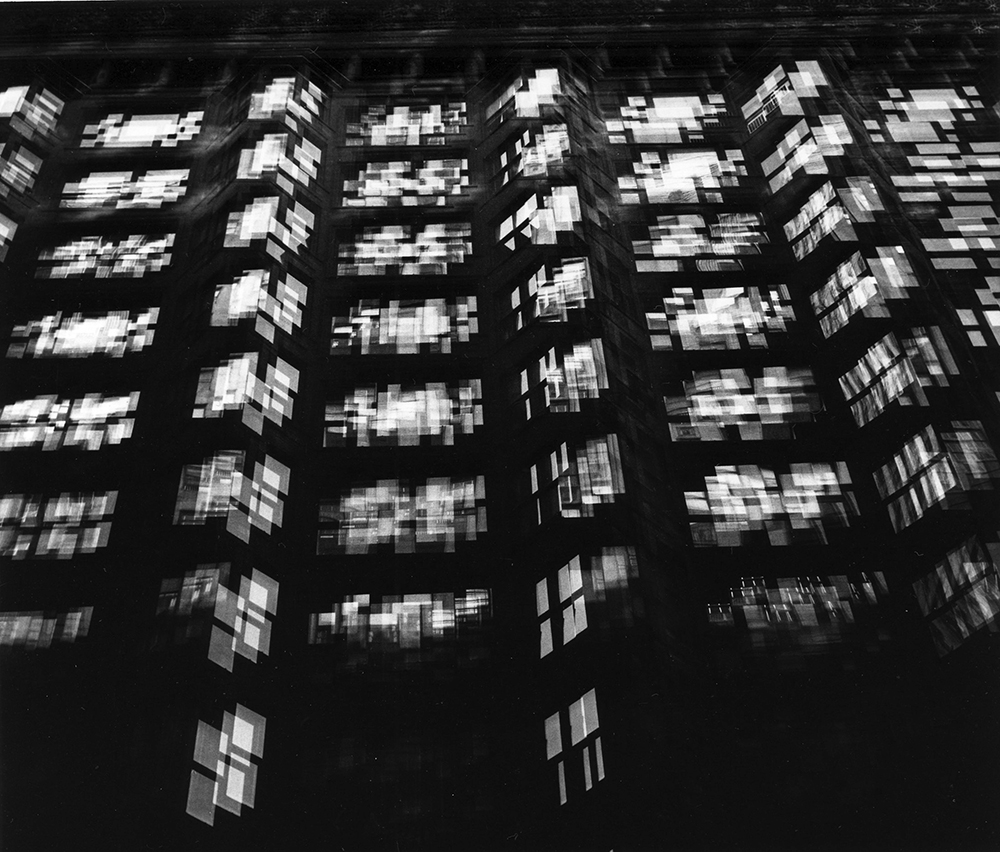
What interests me in this approach is not to reproduce it. It is the idea that black and white can remove the world’s immediate appearance in order to reveal a more nervous structure.
In my work, that structure remains tied to instinct. I am not only looking for a graphic composition. I am looking for the moment when something resists within the image: a presence, an absence, a friction, a trace.
Removing the scenery does not mean removing the city
I do not want to photograph clean scenes.
I am not looking for a street emptied of its flaws, its signs, its shop windows, its waste, its obstacles, its dirty or untidy areas. The city interests me precisely because it overflows.
But I do not want the city to become scenery.
Scenery is used to situate. It reassures. It provides a background. It allows us to say: this image was taken here, in this street, in this city, at that moment. It gives the viewer a comfortable hold.
Matter acts differently.
It does not only situate. It rubs. It weighs. It disturbs. It collides with the rest of the image. A shop window can cut a face. A shadow can absorb a body. A wall can crush a silhouette. A line can cross a scene like a fracture.
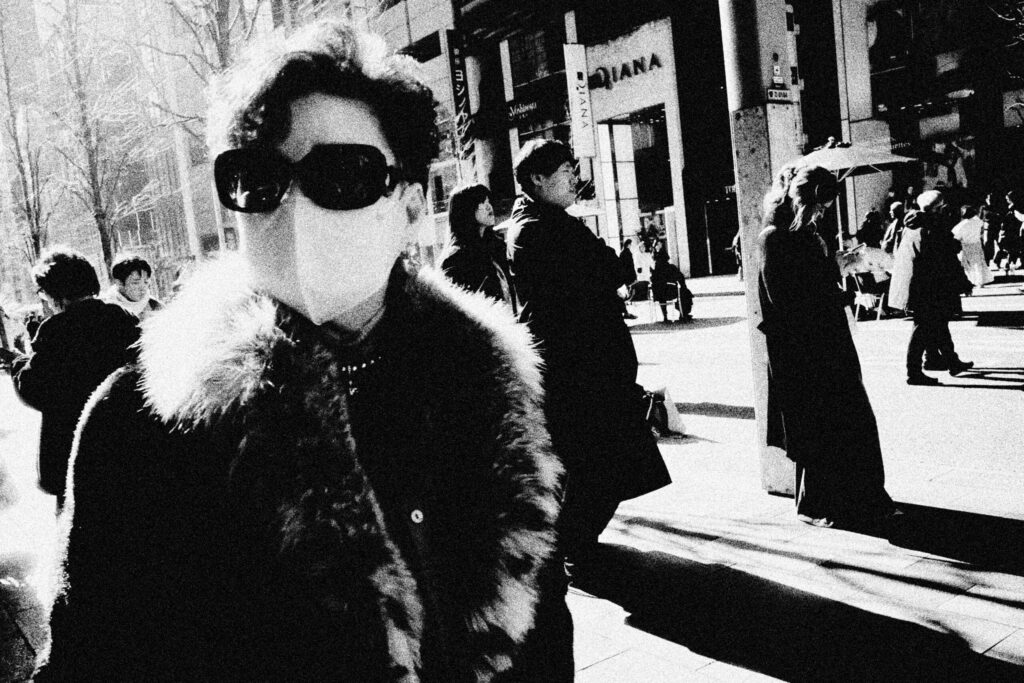
Black and white more easily turns scenery into matter because it removes part of its descriptive power. A red car is no longer a red car. It is a gray or black mass within the frame. A colorful sign is no longer a seductive advertisement. It is a luminous form. A façade is no longer a pleasant or ugly façade. It is a surface.
The city remains there. But it stops being illustrative.
Black and white exposes more than it hides
One might think that black and white simplifies. In reality, it exposes.
It exposes the weakness of a frame. It exposes the absence of tension. It exposes a photograph that relied only on a seductive color. It exposes images that are too easy, too pretty, too decorative.
That is why it can be cruel.
When color disappears, the image must hold through something else. A relation of masses. A direction. A contrast. A form. A density. An imbalance. A physical sensation.
Black and white should not be a filter added at the end. It should be a way of looking.
One has to learn to see what will remain once color is removed. What will survive. What will fall away. What will become stronger. What will become useless.
It is a simple but brutal question: if I remove color, is there still a photograph?
Often, the answer is no.
And that is very good. It forces one to look more severely.
Why I continue to choose black and white
I continue to work in black and white because this subtraction corresponds to my way of photographing.
I am not trying to explain everything. I am not trying to produce likeable images. I am not trying to make the street more beautiful than it is. I photograph fragments, tensions, passages, surfaces, gestures, traces. Things seen too quickly, sometimes too close, sometimes almost missed, but that keep something.
Black and white helps me remove what distracts. It does not do the work for me. It does not give soul to the images. It does not automatically transform an ordinary scene into a photograph.
But when it works, it removes the scenery.
It removes color as one removes a layer of noise. It leaves the scene more bare, harder, more exposed. It does not say: look how beautiful this is. It says instead: look at what remains.
And what remains is not always spectacular.
Sometimes it is a body. Sometimes it is a shadow. Sometimes it is an absence. Sometimes it is a tiny trace in the corner of the frame. Sometimes it is only a tension I would not know how to explain otherwise.
This may be where black and white photography becomes necessary: when it no longer serves to decorate the world, but to remove what prevented us from seeing it.